

Psychology and Nature·the alignment we lost
The human mind was shaped by the same forces that shaped every mind on this planet. We are not separate from the animal kingdom — we are part of it. The psychological architecture we carry evolved over millions of years in continuity with the rest of the living world. The divergence was recent. The re-alignment may be the work of our lifetime. Information only, not professional advice.
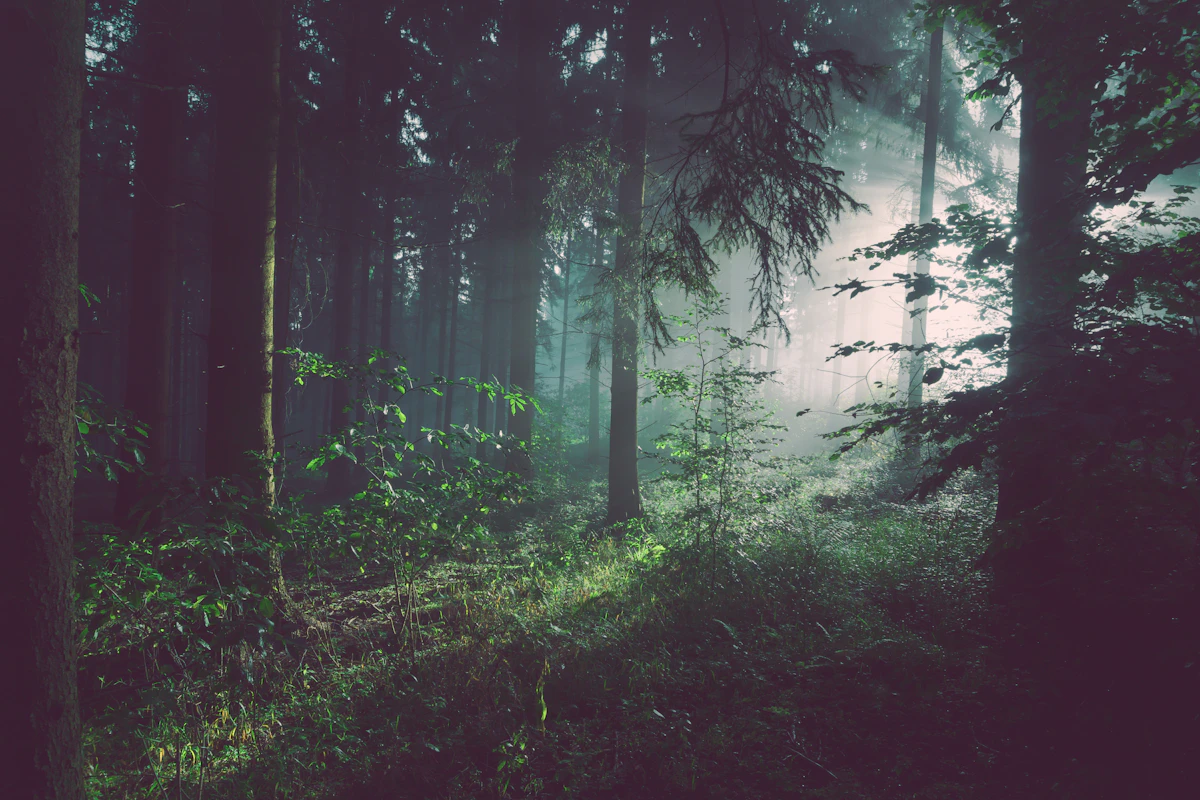
Photo: Aaron Burden / Unsplash
The mind we share
In 1872, Charles Darwin published "The Expression of the Emotions in Man and Animals." His argument was simple and radical: the emotional lives of humans and animals are not separated by a wall. They are points on a continuum. Fear, rage, joy, grief, surprise, disgust — the core emotions that drive human behaviour are expressed in the faces, postures, and vocalisations of other animals in ways that are recognisable, measurable, and homologous. The same facial muscles contract. The same neural circuits fire. The difference is one of degree, not of kind.
This was not a romantic claim. It was an empirical one, and it has been confirmed by 150 years of subsequent research. Frans de Waal, the Dutch primatologist who spent his career at Emory University and the Burgers Zoo in Arnhem, documented this continuity with extraordinary precision. In "Mama's Last Hug" (2019), he described the final encounter between Mama, an elderly chimpanzee matriarch, and Jan van Hooff, the biologist who had known her for 40 years. Mama was dying. She recognised Jan, reached out, stroked his face, and held him. The video went viral. People recognised something in it that science had been reluctant to say plainly: this was love. This was grief. This was recognition. The chimp's emotion was not analogous to a human emotion. It was the same emotion, expressed through the same evolutionary channel.
De Waal distinguishes carefully between emotions and feelings. Emotions are physiological — the body's response to a situation: heart rate, facial expression, hormone release. Feelings are the conscious awareness of those emotions. Animals clearly have emotions. Whether they have feelings — the conscious experience of those emotions — was debated for centuries. In 2012, a panel of neuroscientists gathered at the Francis Crick Memorial Conference at Cambridge University and signed the Cambridge Declaration on Consciousness. The declaration stated plainly: non-human animals, including all mammals and birds, possess the neurological substrates of consciousness. They are not automata. They experience. The alignment between human and animal psychology is not a metaphor. It is a biological fact.
The human mind and the animal mind are not different things. They are the same thing, expressed at different scales of complexity. The emotions you feel — love, fear, grief, joy, rage — are the same emotions a chimpanzee feels, an elephant feels, a dog feels. The architecture is shared. The continuity is real. The difference is in the scaffolding built on top of it, not in the foundation underneath.
If the emotional architecture is shared, when you watch a grieving elephant or a joyful dog, are you projecting human feelings onto them — or recognising your own?
Are the pyramids the same?
In 1943, psychologist Abraham Maslow proposed a hierarchy of human needs: physiological (food, water, warmth), safety (shelter, security), belonging (love, friendship, community), esteem (status, respect), and self-actualisation (becoming who you are). It has shaped how we think about human motivation for 80 years. Chris's question is precise: does this same pyramid exist in the animal kingdom?
The first four tiers map with striking clarity. Physiological needs are universal — every living organism requires sustenance. Safety needs: predator avoidance, territory defence, and shelter-seeking are documented across virtually every species studied. Belonging: pack bonding in wolves, pod cohesion in whales, troop hierarchy in primates, flock dynamics in birds — the social need is not uniquely human. Esteem: alpha dynamics in wolves, silverback authority in gorillas, pecking orders in chickens, display behaviours in birds of paradise, the mane of a dominant lion — status and recognition are woven through animal societies from top to bottom.
The fifth tier — self-actualisation — is where the question becomes interesting. Is there an animal equivalent of the drive to become who you are? The evidence is suggestive, not conclusive. New Caledonian crows, documented by Gavin Hunt in 1996, manufacture hooked tools from twigs — selecting raw materials, trimming, sculpting in three dimensions. This is not instinct alone. It involves problem-solving, creativity, and what looks like craftsmanship. Bowerbirds build elaborate, decorated structures not for shelter but for courtage — symmetrical arrangements of coloured objects, adjusted for aesthetic effect. Humpback whale songs evolve over time, with new phrases spreading through populations like cultural innovations. These are not survival behaviours. They are explorations of capacity. They look, as much as anything in the animal kingdom can, like self-actualisation expressed through the medium available to each species.
Psychologist Gordon Burghardt at the University of Tennessee developed five criteria for identifying play in animals — behaviour that is not fully functional, is voluntary, is repeated, occurs in relaxed contexts, and is not a replica of adult functional behaviour. Play has been documented in mammals, birds, reptiles, fish, and even octopuses. Play is the animal equivalent of self-actualisation: behaviour that serves no survival purpose except the development of the organism itself. The pyramid is not identical across species. But the architecture is remarkably similar. The foundations are universal. The upper tiers become more elaborate in species with larger brains and longer childhoods. The shape is the same. The height differs.
The psychological pyramid is not uniquely human. Every tier — survival, safety, belonging, esteem, even the drive toward self-actualisation — has its analogue in the animal kingdom. The pyramids are the same shape. What differs is how high each species can climb. And the species that can climb highest is the one that has the most to lose when it forgets the foundations.
If every tier of your needs pyramid exists in the animal kingdom, what makes you think the pyramid itself is yours?


The ones who remember and grieve
Cynthia Moss has studied the elephants of Amboseli, Kenya, for nearly 50 years. The Amboseli Elephant Research Project, founded in 1972, is the longest-running study of wild elephants in the world. What she and her colleagues documented has changed our understanding of animal psychology.
Elephants grieve. This is not anthropomorphism. When an elephant encounters the bones of a dead elephant, it stops. It touches them — gently, with its trunk. It examines the skull and the tusks. Elephants have been observed standing vigil at the carcasses of family members for days, refusing to leave. They return to the site of a death months or years later, touching the bones again. The Amboseli researchers documented greeting ceremonies, responses to deceased herd members that parallel human mourning behaviour, and what can only be described as funerary behaviour — covering the dead with branches and earth.
Elephants remember. Matriarchs — the oldest females, who lead elephant herds — have been documented leading their families to water sources they visited decades earlier, during droughts that occurred before the younger elephants were born. In 2009, during a severe drought in Amboseli, the herds led by older matriarchs had significantly higher calf survival rates. The matriarchs remembered where water had been during the last drought, decades ago, and led their families there. Memory is not just cognition. It is survival. And the capacity to remember is inseparable from the capacity to grieve — because you can only grieve for what you remember.
Elephants show empathy and altruism. They help injured herd members, supporting them with their bodies. They rescue calves stuck in mud. They have been observed responding to the distress calls of other elephants — not just family members, but strangers. They cooperate to solve problems. They console each other after conflict, using their trunks to touch and calm distressed individuals. The parallel to human grief, human memory, human empathy — the parallel to the deepest parts of human psychology — is not metaphorical. It is structural.
An elephant grieves for its dead. An elephant matriarch leads her family to water she last saw 30 years ago. An elephant comforts a stranger in distress. If these are not grief, memory, and empathy — then those words do not mean what we think they mean.
When an elephant stands vigil at the bones of a family member who died years ago, what is it feeling? And if it is what we think it is, why do we still treat them as different from us?
Culture in the deep
Hal Whitehead, a biologist at Dalhousie University, has spent decades at sea studying sperm whales, dolphins, and orcas. In 2015, with Luke Rendell, he published "The Cultural Lives of Whales and Dolphins" — a book that argued, with extensive evidence, that cetaceans have culture. Not in the loose sense of "habits." In the precise sense: behaviours that are learned from others, vary between groups, and persist across generations.
Humpback whale songs are the most striking example. Male humpbacks sing complex, structured songs lasting up to 30 minutes, which they repeat for hours. The songs evolve — new phrases are added, old ones are dropped, patterns shift. And the changes spread. A study published in the Royal Society's Proceedings of the Royal Society B documented how humpback whale song revolutions spread from the western South Pacific to eastern Australia — cultural transmission across thousands of kilometres of ocean, as one population's song replaced another's. This is not genetics. This is culture — socially learned, collectively evolving, geographically variable. The same process that shapes human language, human music, human fashion.
Orcas take this further. Different orca pods have different dialects — distinct call repertoires that identify their family group. They have different hunting techniques: some pods beach themselves to catch seals; others blow bubbles to herd fish; some have learned to knock seals off ice floes with coordinated waves. These techniques are taught, not instinctive. Young orcas learn by watching their mothers and pod-mates. Different pods have different social norms — some are highly social, some more solitary, some tolerate other pods, some do not. These are not biological differences. They are cultural ones. They are orca traditions.
The parallel to human culture is not a stretch. Language, dialect, technology, tradition, regional identity, intergroup tolerance or hostility — the same categories that describe human cultural variation describe orca cultural variation. The medium is different. The structure is the same. And the question it raises is the same one Chris asks: if whales have culture, and humans have culture, and both cultures serve the same psychological functions — identity, belonging, transmission of knowledge, adaptation to environment — then the alignment is not just in the emotions. It is in the deepest architecture of social mind.
Whales have songs that evolve and spread across oceans. Orcas have dialects, traditions, and regional cultures. These are not instincts. These are learned, transmitted, evolving — they are culture. The same force that shapes human culture shapes whale culture. The ocean is not silent. It is full of voices, learning from each other, the way we do.
If whales teach their young how to hunt, if their songs spread like hits across the ocean, if their pods have distinct cultures — what is the difference between their culture and ours, other than the medium?


Politics, power, and the tribe
Craig Packer took over the Serengeti Lion Project in 1978 and has studied lions for nearly 50 years. Lions, he found, are the only truly social cats. They live in prides — groups of related females and their young, plus a coalition of males who hold the territory. The females do the hunting, raise the cubs cooperatively, and defend the territory. The males defend the pride against rival coalitions. The system is kinship-based, territorial, cooperative, and hierarchical. The parallels to human tribal structure — extended family groups, territorial defence, cooperative labour, male coalition politics — are clear.
Lions also show the darker side of social psychology: infanticide. When a new male coalition takes over a pride, they frequently kill the existing cubs. This is not cruelty. It is evolutionary strategy — eliminating the genes of rivals and bringing the females back into oestrus. It is also documented in some human societies, historically. The psychology is the same: power transitions are dangerous for the young. The territorial instinct — defend the border, protect the in-group, expel the outsider — is shared. It is the same instinct that drives human nationalism, human warfare, the human capacity for "othering." Lions did not invent it. Humans did not invent it. It is ancient. It is in the architecture.
Frans de Waal's "Chimpanzee Politics" (1982), based on years of observation at Burgers Zoo, documented something even more familiar. The chimpanzee colony he studied had a political structure that would be recognisable to any student of human power: coalitions, strategic alliances, betrayals, reconciliations, and the use of social intelligence rather than brute strength to achieve and maintain dominance. One alpha maintained his position not through physical force but through strategic partnerships with other males. When those partnerships broke down, he fell. The replacement alpha built his own coalition. This is politics. Not in a metaphorical sense. In a structural sense. The same dynamics of power, alliance, and social intelligence that shape human political behaviour are present in chimpanzee society.
Bonobos, our other closest relatives, offer a contrast. Where chimpanzees resolve conflict through dominance and alliance, bonobos resolve it through social bonding — physical contact, grooming, and sexual activity. Bonobo society is matriarchal. Violence is rare. Cooperation is high. The same genus, two species, two strategies for managing social life. Humans, it could be argued, carry both — the chimpanzee instinct for hierarchy and the bonobo instinct for bonding. The question is which one we choose to amplify.
Koko the gorilla, who learned over 1,000 signs in American Sign Language through the research of Penny Patterson, provided one of the most emotionally resonant examples of cross-species psychological alignment. When her kitten, All Ball, died, Koko signed "cry, sad, frown." Whether Koko's signing reflected the same internal experience as human grief is debated — the scientific controversy around Patterson's methods is real and must be stated honestly. But the behavioural evidence — a gorilla who had cared for a kitten, who expressed distress when told of its death — is consistent with what we now know about the emotional lives of great apes. Grief is not a human invention. It is a mammalian inheritance.
Lions have tribes and territories. Chimpanzees have politics and alliances. Bonobos have bonding and reconciliation. Gorillas show grief. These are not animal versions of human behaviours. These are the original versions. Humans inherited them. We did not invent power, hierarchy, coalition, or grief. We built civilisations on top of them.
If chimpanzees form political alliances, if lions defend territorial borders, if gorillas grieve — what part of human political behaviour is uniquely human, and what part is simply the animal we have always been?
From the largest to the smallest
The alignment extends downward through the animal kingdom into organisms that seem too simple to possess psychology at all. The question is: how far down does it go?
The C. elegans nematode has exactly 302 neurons. Its entire nervous system has been mapped — every neuron, every connection. It is the most completely understood nervous system on Earth. And yet, with 302 neurons, C. elegans demonstrates learning. It learns to approach or avoid chemical cues associated with food or danger. It forms memories that persist. It shows habituation — learning to ignore repeated, irrelevant stimuli — and sensitisation — becoming more responsive after a noxious stimulus. Research published through MIT's Brain and Cognitive Sciences department has shown that C. elegans has "a rich repertoire of learning and memory behaviour." With 302 neurons. How much psychology is there in 302 neurons? Enough to learn. Enough to remember. Enough to change behaviour based on experience.
Honeybees, studied by Karl von Frisch (who received the Nobel Prize for this work in 1973), communicate through the waggle dance — a structured movement that tells other bees the direction and distance of a food source. This is symbolic communication. The dance encodes information about something that is not present — a food source miles away. The bee that watches the dance receives information about a place it has never been and flies there. This is not instinct. It is learned, symbolic, referential communication. The parallel to human language is not exact, but the principle — using symbolic movement to convey information about absent things — is the same.
Deborah Gordon at Stanford has spent decades studying ant colonies. Her finding: ant colonies make collective decisions without any central control. No ant tells another what to do. Each ant follows local rules — respond to chemical signals, adjust behaviour based on encounter rates — and from these local interactions, collective intelligence emerges. The colony decides when to forage, where to nest, how to allocate workers. This is the same principle that governs human markets, human crowds, human social networks — collective behaviour emerging from local interactions without central planning. The slime mould Physarum polycephalum, with no brain at all, solved a network optimisation problem that took human engineers decades to design. In a 2010 experiment published in Science, Atsushi Tero placed Physarum on a map of Tokyo, with food sources representing the cities around the capital. The slime mould grew a network that was comparable in efficiency, reliability, and cost to the actual Tokyo rail network. No brain. No neurons. No consciousness. And yet, the capacity to solve spatial optimisation problems that human engineers found genuinely difficult.
The alignment does not stop at the boundary of mammals or birds. It runs through the entire living world. From the whale with the largest brain on Earth to the nematode with 302 neurons, the principles are the same: learn, remember, communicate, cooperate, adapt. The scale changes. The architecture does not.
From the largest brain on Earth (the sperm whale, at 8 kilograms) to one of the smallest (the C. elegans nematode, with 302 neurons), the fundamental capacities are the same: learning, memory, communication, adaptation. Psychology is not a human invention. It is a property of nervous systems. And nervous systems have been solving the same problems for 600 million years.
If a worm with 302 neurons can learn and remember, and a whale with the largest brain on Earth can teach and grieve, what does that say about the continuity of mind? Where exactly do you draw the line?


The neurochemistry we share
The alignment is not only behavioural. It is chemical. Sue Carter, former Director of the Kinsey Institute, spent decades studying prairie voles — small rodents that form lifelong pair bonds. Her research revealed that oxytocin, a hormone produced in the hypothalamus, is central to the formation of social bonds. Prairie voles, who are monogamous, have oxytocin and vasopressin receptors distributed differently in their brains than montane voles, who are promiscuous. Same hormone, different receptor pattern, different social behaviour. The chemistry of love — of attachment, of bonding — is not uniquely human. It is mammalian. The same oxytocin that floods a human mother's brain when she holds her newborn floods a prairie vole's brain when it mates. The same circuit. The same chemistry. Different species, different expressions, same architecture.
Mirror neurons, discovered by Giacomo Rizzolatti and his team at the University of Parma in the 1990s, add another layer. These are neurons that fire both when an animal performs an action and when it watches another animal perform the same action. They were first found in macaque monkeys, in the premotor cortex. When the monkey reaches for a peanut, a specific set of neurons fires. When the monkey watches a researcher reach for a peanut, the same neurons fire. The brain simulates the other's action. The controversy around mirror neurons — how exactly they work, whether they truly underlie empathy, whether they exist in humans in the same form — is real and ongoing. But the core finding is not in dispute: the brain contains mechanisms for representing the actions and experiences of others. The neurological substrate of empathy — the capacity to feel what another feels — is not a human invention. It is a primate inheritance. And it likely extends further than we yet know.
The chemistry of love is the same in a prairie vole and a human. The neural mechanisms of empathy were found first in a monkey. The architecture of bonding, of feeling what another feels, is not a human achievement. It is a mammalian inheritance, refined by evolution over tens of millions of years.
If the same hormone that bonds a vole to its mate bonds a mother to her child, and the same neurons that help a monkey understand another's action help you understand your friend's pain — then the connection you feel to others is not a choice. It is chemistry. It is biology. It is the same biology in every mammal on Earth.
When the alignment broke
For hundreds of thousands of years, human psychology was aligned with the psychology of nature. Homo sapiens lived as foragers — in small bands of 20 to 80 individuals, moving with the seasons, hunting and gathering, sharing food, raising children cooperatively, sleeping when it was dark, waking when it was light. The psychological profile of hunter-gatherer societies, studied by anthropologists in the few remaining groups — the Hadza of Tanzania, the San of the Kalahari, the !Kung of Namibia — is remarkably consistent: egalitarian, cooperative, low-hierarchy, high-social-bonding. Marshall Sahlins, in his 1972 essay "The Original Affluent Society," argued that hunter-gatherers were not impoverished primitives scraping by, but affluent in the most meaningful sense: they worked fewer hours, had stronger social bonds, and lived in closer alignment with the psychological architecture they had evolved for.
The alignment began to break approximately 12,000 years ago, with the Agricultural Revolution. Jared Diamond, in his 1987 essay "The Worst Mistake in the History of the Human Race," argued that agriculture brought not progress but decline: reduced stature, increased disease, longer working hours, the introduction of gross social and sexual inequality, and the emergence of despotism. The archaeological evidence supports much of this: hunter-gatherer skeletons show better nutrition, fewer signs of disease, and less evidence of interpersonal violence than early agricultural skeletons. Agriculture produced surplus. Surplus produced hierarchy. Hierarchy produced the psychological structures that define modern life: ownership, accumulation, social stratification, and the concept of "mine" as opposed to "ours."
The break deepened with philosophy. In the 17th century, René Descartes proposed that animals were automata — machines without consciousness, incapable of feeling pain. This "animal-machine" doctrine, rooted in the Cartesian separation of mind and body, gave Western civilisation permission to treat animals as objects. Francis Bacon had already framed science as the "conquest of nature." The Judeo-Christian reading of Genesis granted humanity "dominion" over the living world. Together, these ideas created a philosophical wall between human and animal psychology — a wall that did not exist in Indigenous, Eastern, or animist traditions, which maintained the continuity between human and non-human minds.
The final severing came with the Industrial Revolution, 250 years ago. Urbanisation moved the majority of humans away from daily contact with nature. Artificial light disconnected us from the rhythm of the sun. Climate control disconnected us from the rhythm of the seasons. The 24/7 economy disconnected us from the rhythm of rest. The hunter-gatherer who slept when it was dark and woke when it was light, who moved with the herds and ate what the land provided, who understood themselves as part of an ecosystem — that psychology was replaced by a psychology of separation. Nature became "the environment" — something out there, something to be managed, something other. The alignment that had held for 300,000 years of Homo sapiens and millions of years of hominid evolution was, in evolutionary terms, broken almost overnight.
The alignment broke in stages. First, agriculture: the shift from foraging to farming, from sharing to storing, from egalitarian bands to hierarchical settlements. Then, philosophy: the Cartesian wall that made animals into machines and nature into a resource. Finally, industry: the move indoors, the severing of daily contact with natural rhythms. Each stage took us further from the psychology we evolved for. Each stage deepened the wound.
If the alignment held for 300,000 years and has been broken for only 12,000 — and most severely for only 250 — then which version of human psychology is the anomaly: the one shaped by nature, or the one that forgot it?

The cost of disconnection
The consequences of the break are measurable. Richard Louv, in "Last Child in the Woods" (2005), coined the term "nature deficit disorder" to describe the psychological cost of disconnection from the natural world — increased anxiety, reduced attention, diminished creativity, and what he called a "diminished use of the senses." The research has grown substantially since. The Kaplan brothers' Attention Restoration Theory, published in 1995, demonstrated that natural environments restore depleted attention through "soft fascination" — the gentle, effortless attention that falling water, rustling leaves, and moving clouds demand — in contrast to the "hard fascination" of screens, which depletes attention. Studies have shown that even brief exposure to natural scenes can restore cognitive function.
In Japan, Dr. Qing Li at Nippon Medical School pioneered research on shinrin-yoku — forest bathing. His studies, published in peer-reviewed journals, demonstrated that time spent in forests reduces cortisol levels, lowers blood pressure, decreases sympathetic nerve activity (the fight-or-flight response), and increases natural killer cell activity (part of the immune system). The physiological stress response that urban life maintains at a constant, low-grade hum — the cortisol that keeps us alert, anxious, and on edge — is measurably reduced by contact with the natural environments our bodies evolved to inhabit.
E.O. Wilson, in "Biophilia" (1984), proposed that humans have an innate, evolutionary need for connection with nature and other living things — and that psychological health depends on it. The biophilia hypothesis has been supported by a growing body of research: studies on green space and mental health, nature exposure and depression rates, the psychological benefits of pet ownership, and even the calming effect of natural sounds. The hypothesis is not that nature is a luxury. It is that disconnection from nature is a psychological injury — an injury that modern civilisation inflicts on every generation, starting in childhood.
Gay Bradshaw's 2005 paper "Elephant Breakdown," published in Nature, added a disturbing dimension. She documented PTSD in elephants — not metaphorical PTSD, but symptoms that matched the diagnostic criteria for human post-traumatic stress disorder. In areas of heavy poaching, elephant society had broken down. Young elephants who had witnessed their mothers being killed showed abnormal aggressive behaviour, hyperarousal, and social dysfunction. The same trauma responses that human psychology recognises in soldiers, in abuse survivors, in refugees — the same architecture of psychological injury — was present in elephants. And if elephants can be traumatised by violence, and humans can be traumatised by disconnection from nature, then the wound runs in both directions. We injure animals by destroying their social worlds. We injure ourselves by destroying our connection to theirs.
The cost of disconnection is not a feeling. It is a measurable physiological and psychological injury. Forests reduce cortisol. Green space reduces depression. Nature deficit increases anxiety. And the elephants who witnessed their families being killed developed the same PTSD that humans develop. The wound is real. It is shared. And it is growing.
Everyday example A child grows up in a flat, goes to school in a building, plays on a phone, and watches screens in the evening. They see more pixels than leaves. They cannot name three local birds. They have never watched a sunset without a phone in their hand. They are anxious, distracted, and irritable. The adults call it a disorder. It is not a disorder. It is a disconnection. The cure is older than the illness.
If your body evolved to live in a forest, and you live in a flat, what medication could possibly replace what you lost? And if the answer is "nothing," then what?
What seems separate is connected
Several threads of research, which at first seem tangential to the question of human-animal psychological alignment, turn out to be core to it. Chris asked for these. Here they are.
Branch 1 — Animal consciousness and the hard problem
If animals are conscious — and the Cambridge Declaration on Consciousness (2012) signed by a panel of neuroscientists states that all mammals and birds possess the neurological substrates of consciousness — then the alignment between human and animal psychology is not metaphorical. It is literal. The same consciousness that looks out through your eyes looks out through a chimpanzee's eyes, an elephant's eyes, a crow's eyes. This connects directly to the topics on this site about light, frequency, and reality: if consciousness is the observer, and the observer is part of what is observed, then the consciousness in an elephant and the consciousness in you are not different phenomena. They are the same phenomenon, experiencing itself through different instruments.
Branch 2 — Collective intelligence and the question of civilisation
Slime moulds solve network optimisation problems. Ant colonies make collective decisions. Flocks and schools demonstrate emergent intelligence. These are not metaphors for human collective behaviour. They are the same principle — intelligence emerging from local interactions without central control. The question this raises is uncomfortable: is human civilisation actually a form of collective intelligence, or is it a departure from natural collective intelligence? Cities, markets, and social networks look like collective intelligence. But they also look like something that has lost its connection to the patterns that made natural collective intelligence stable for hundreds of millions of years. Ant colonies do not collapse from within. Civilisations do.
Branch 3 — Trauma across species
Elephants develop PTSD. Isabelle Mansuy at the University of Zurich has demonstrated that trauma can be inherited across generations in mice — the offspring of traumatised mice show altered behaviour and metabolism, even when they were never exposed to the original trauma. The implications are profound: if trauma can be inherited in animals, it can be inherited in humans. The psychological architecture of trauma — its mechanisms, its transmission, its effects — is shared. This connects to the topic on Addictions: if addiction is a response to pain, and pain can be inherited, then the cycle of pain and addiction may be older and deeper than any individual's choices. The path out is not individual willpower. It is collective healing — the same collective healing that a traumatised elephant herd needs.
Branch 4 — Play as psychological architecture
Peter Gray, a psychologist at Boston College, has argued that hunter-gatherer societies maintained their egalitarian social structure through play — not play as leisure, but play as the fundamental mode of social interaction. Hunting, gathering, religious practice, and conflict resolution all had gamelike qualities in hunter-gatherer bands. Play, he argues, is the mechanism that keeps dominance in check. When play disappears, hierarchy rises. The same dynamic is visible in animals: Gordon Burghardt's research shows that play is present in mammals, birds, reptiles, fish, and octopuses — and that play deprivation produces the same behavioural distortions in animals that nature deficit produces in children. Play is not a luxury. It is the psychological architecture that keeps social life healthy — in humans and in animals alike.
Branch 5 — Territoriality and the psychology of "othering"
Lions defend territory. Ants defend colony boundaries. Birds defend nesting sites. Humans defend borders. The territorial instinct is ancient, shared, and psychological — not merely behavioural. The same neurochemistry that drives in-group bonding (oxytocin) also drives out-group suspicion. Research has shown that oxytocin increases trust toward in-group members and increases defensiveness toward out-group members. The instinct that bonds us to our own is the same instinct that alienates us from others. This is the psychological root of nationalism, racism, and war — and it is not a human invention. It is a mammalian inheritance. The question is not whether we can eliminate it. We cannot. The question is whether we can become conscious of it — can we see the territorial instinct for what it is, an ancient survival mechanism, and choose to override it with the equally ancient instinct for cooperation that also lives in our architecture?
If consciousness, collective intelligence, trauma, play, and territoriality are all shared with animals, then what exactly is the wall between us? And what would happen if we stopped pretending it exists?


The path back to alignment
Re-alignment is not regression. It is not a call to abandon civilisation and return to the savannah. It is the recognition that the psychology we carry was shaped by the natural world, that disconnection from that world has measurable psychological costs, and that deliberate re-connection is possible, necessary, and already happening.
Robin Wall Kimmerer, a botanist and member of the Potawatomi Nation, wrote in "Braiding Sweetgrass" (2013) about the indigenous worldview that maintains the alignment Western civilisation has lost. In the Potawatomi tradition, the natural world is not a resource. It is a community of relations. Plants are not commodities — they are teachers. Animals are not resources — they are kin. The language itself encodes this: the Anishinaabe word "mitákuye oyásin" — "all my relations" — encompasses not just family but all living things. This is not a metaphor. It is a psychological orientation. And it produces a different relationship with the natural world: reciprocity rather than extraction, gratitude rather than ownership, belonging rather than dominion. The psychological health that Indigenous communities maintained for thousands of years was not accidental. It was the result of a worldview that kept human psychology aligned with the psychology of nature.
The field of ecopsychology, pioneered by Theodore Roszak in "Ecopsychology: Restoring the Earth, Healing the Mind" (1995), treats the human-nature disconnection as a root cause of psychological distress. The argument is not that nature is a therapy tool — it is that disconnection from nature is itself the pathology. Many modern psychological disorders — anxiety, depression, attention deficits, addiction — can be understood, at least in part, as symptoms of a deeper disconnection from the natural rhythms and relationships our psychology evolved to depend on. The treatment is not medication alone. It is re-connection: time in nature, relationships with animals, the restoration of seasonal rhythms, the practice of attention to the living world.
What would re-alignment look like, practically? It would look like what we already know works: green spaces in cities. Forest schools for children. Time outdoors. Relationships with animals. Attention to the seasons. The restoration of play — for children and adults. The practice of seeing animals as kin, not commodities. The recognition that the psychological architecture we carry is not a human invention but a planetary inheritance — and that honouring it is not sentimental. It is therapeutic. It is, possibly, the only way forward that does not end in deeper disconnection and deeper psychological distress.
We would be better as a species if we re-aligned with the psychology of nature. Not because nature is perfect — nature contains predation, disease, and death. But because the psychology we evolved for is the psychology of nature, and living against our own architecture produces suffering. The elephant that grieves, the whale that teaches its young, the ant colony that makes collective decisions, the prairie vole that bonds for life, the crow that crafts tools, the nematode that learns — these are not lesser versions of human psychology. They are the same psychology, expressed in different bodies, shaped by the same forces, carrying the same ancient architecture. We are not above them. We are among them. The alignment we lost is the alignment we need. The path back is not behind us. It is through.
Re-alignment is not going back. It is going through — through the recognition that the mind we carry is a natural mind, that the emotions we feel are natural emotions, and that the disconnection we experience is not a sign of progress. It is a wound. The wound can be healed. The architecture is still there. It has been there for 600 million years. It is patient. It is waiting for us to remember.
If the path back to alignment is not behind us but through us, what is the first step you could take tomorrow morning?
One species among many
The human mind was shaped by the same forces that shaped every mind on this planet. Love, grief, cooperation, hierarchy, empathy, territoriality, play, curiosity — these are not human inventions. They are the architecture of animal psychology, refined over hundreds of millions of years of evolution, carried forward in every species that survived. Humans did not invent them. We inherited them. And the inheritance is not a legacy. It is a living connection — to the elephants who grieve, the whales who teach, the lions who defend, the chimpanzees who scheme, the crows who craft, the ants who cooperate, the voles who bond, the worms who learn.
The alignment held for 300,000 years of Homo sapiens. It has been broken for 12,000 — and most severely for 250. In evolutionary terms, the break is an eyeblink. In that eyeblink, we have built extraordinary things: science, medicine, art, philosophy, the capacity to understand our own psychology and the psychology of the animals we share the planet with. But we have also built disconnection, isolation, a civilisation that treats the natural world as a resource and the animal mind as a curiosity. The extraordinary things and the destructive things come from the same source: a mind that was shaped by nature, now trying to live against the shape it was given.
The question is not whether we can go back. We cannot. The question is whether we can go forward with the knowledge that we are not separate. The psychological pyramid is the same. The neurochemistry is the same. The emotions are the same. The capacity for trauma is the same. The capacity for healing is the same. We are one species among millions — not above them, not below them, among them. The alignment we lost is not lost forever. It is waiting, the way a forest waits for rain. The architecture is there. It has always been there.
One species. One Earth. One chance to remember what we have always been.
We are one species among millions. Our psychology is not a human creation — it is a planetary inheritance, shared with every animal that loves, grieves, plays, bonds, and learns. The alignment we lost can be found again. Not by going back, but by going through — through the recognition that the animal kingdom is not other. It is us, in a different body, carrying the same ancient mind.
Everyday example This page was researched using non-Wikipedia sources exclusively. Primary sources include: Charles Darwin "The Expression of the Emotions in Man and Animals" (1872); Frans de Waal "Chimpanzee Politics" (1982) and "Mama's Last Hug" (2019); Cynthia Moss and the Amboseli Elephant Research Project (elephanttrust.org); Hal Whitehead and Luke Rendell "The Cultural Lives of Whales and Dolphins" (2015); Craig Packer and the Serengeti Lion Project (lioncenter.umn.edu); Cambridge Declaration on Consciousness (2012, fcmconference.org); Sue Carter's oxytocin research (Kinsey Institute); Giacomo Rizzolatti's mirror neuron research (University of Parma); Gordon Burghardt "The Genesis of Animal Play" (2005); Peter Gray's hunter-gatherer play research (Boston College); E.O. Wilson "Biophilia" (1984); Richard Louv "Last Child in the Woods" (2005); Qing Li's forest bathing research (Nippon Medical School); Gay Bradshaw "Elephant Breakdown" (Nature, 2005); Isabelle Mansuy's trauma inheritance research (University of Zurich); Deborah Gordon's ant colony research (Stanford); Atsushi Tero's slime mould research (Science, 2010); Irene Pepperberg and Alex the parrot (alexfoundation.org); Gavin Hunt's New Caledonian crow research; Karl von Frisch's bee communication research; Jared Diamond "The Worst Mistake in the History of the Human Race" (1987); Marshall Sahlins "The Original Affluent Society" (1972); Robin Wall Kimmerer "Braiding Sweetgrass" (2013); Theodore Roszak "Ecopsychology" (1995); Kaplan's Attention Restoration Theory (1995); C. elegans research (MIT Brain and Cognitive Sciences, Cambridge University). The animals described are living beings, not metaphors.
If the mind you carry was shaped by the same forces that shaped every mind on Earth, and if the alignment was broken only yesterday in evolutionary time — then what would it look like, tomorrow morning, to begin remembering?